Understanding people. Unlocking potential.
Workplace Mediation
A confidential, impartial space to resolve conflict and rebuild working relationships
When a working relationship breaks down, the cost shows up in morale, performance and often in formal processes. Mediation offers an earlier, more human route: an impartial mediator helps the people involved talk, understand each other and agree what happens next. I am a UK Mediation accredited mediator.
What it is
A way for people to resolve it for themselves.
Mediation is a way of resolving a dispute or complaint, or of stopping one escalating into something bigger. A trained, impartial professional brings people together, within agreed guidelines, to have a conversation and work out for themselves how to resolve their differences. Nobody is on trial and the mediator does not decide who is right.
Confidential
A lot of what needs to be said is private. Everyone is asked to sign a confidentiality agreement, and nothing is passed on without your consent, unless there are risk or safety concerns.
Impartial
The mediator does not take sides. Everyone gets an equal opportunity to speak, and there are no decisions about rights and wrongs, or blame and fault.
Voluntary
No one can be made to take part, and anyone can step out at any time. Attending the first individual meeting does not commit you to the joint meeting.
Future-focused
Some of what has happened will need discussing, but the focus is on how people want things to change. You do not need to bring evidence or prove your version of events.
You stay in control
The mediator does not impose a solution or judge who is right. The people involved decide what, if anything, is agreed, and nothing is agreed unless everyone is happy with it.
Respectful and practical
We agree ground rules at the start so everyone is heard without interruption. The aim is practical, workable steps that people can realistically keep to afterwards.
Where it can help
When a conversation needs help to happen.
Colleagues in conflict
Two people who can no longer work together comfortably, where the tension is affecting them and the people around them.
Manager and team member
A strained working relationship where trust, expectations or communication have broken down.
Teams under strain
Friction that has spread beyond individuals, with groups forming, conversations avoided and work slowing down.
Before things become formal
An earlier option when a situation is heading towards a grievance, so people can try to resolve it directly first.
Returning to work
Rebuilding working relationships after a period of absence, change or conflict.
Family-run and owner-managed businesses
Where personal and working relationships overlap and disagreements are harder to step away from.
How it works
What to expect on the mediation day.
Before the day, I speak with whoever is arranging the mediation, such as HR or a senior manager, to agree the purpose, who is involved and what happens afterwards.
Step 1
Individual meetings
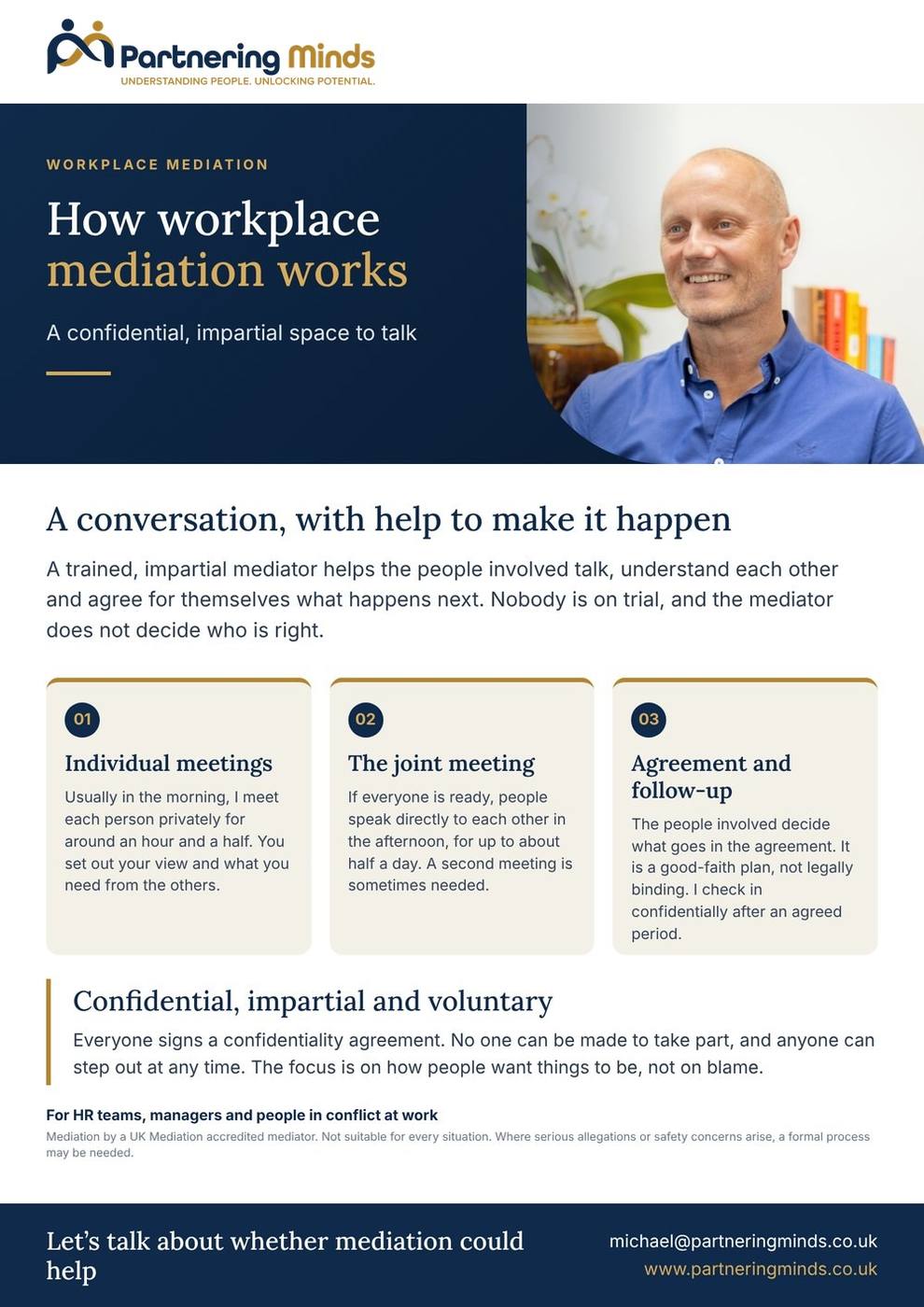
Usually in the morning, I meet each person separately in a private, informal and neutral setting. Each meeting is confidential and lasts around an hour and a half. You set out your view of the issues and what you need from the others involved.
Step 2
Deciding what comes next
If everyone is ready, I set up a joint meeting. If it would not be productive for people to be in the same room yet, I can keep the meetings separate and move between you until you feel ready.
Step 3
The joint meeting
Typically in the afternoon, and lasting up to about half a day. People speak directly to each other about how things reached this point and how to improve the relationship. A second joint meeting is sometimes needed.
Step 4
The agreement
A joint plan of action or summary of improved understanding. The people involved decide what goes in it, and I do not influence its content. I can write it up and send it to everyone. It is a good-faith agreement, not legally binding.
Step 5
Follow-up
After an agreed period, I contact each person confidentially, usually by email, to check whether the agreement is working and whether any further input is needed.
If someone has referred the case, they are not given a copy of the agreement without your consent. If you prefer not to share it, all that needs to be said is that the mediation went ahead and whether it was successful.
Questions and responsible use
What to know before you begin.
Who decides the outcome?
The people involved. The mediator guides the conversation but does not judge or impose a solution, and does not influence what goes in the agreement. It belongs to those who make it.
What if someone does not want to take part?
Mediation only works if it is voluntary, and no one can be coerced into it. Anyone can withdraw at any time without giving a reason. We can start with a private conversation to help someone understand the process, and consider other support if mediation is not right.
Does it replace a formal process?
Not always. Mediation can sit alongside or before formal procedures, but it is not a substitute for an investigation where there are serious allegations.
How long does it take?
A typical mediation runs over one day: individual meetings in the morning and a joint meeting in the afternoon. More complex situations may need a second joint meeting. We agree a realistic plan at the start.
The standards I work to
I am a UK Mediation accredited mediator, and I work to their Code of Practice for accredited mediators. In plain terms, that means:
- Trained and supervised. A nationally recognised, externally accredited mediation qualification at Ofqual level 4 or equivalent, with ongoing case supervision and continuing development.
- Clear from the start. Everyone understands the process and my role, and the confidentiality and business terms are agreed in writing before mediation begins.
- Voluntary. No one is pressured into taking part, and I will step back if I believe someone is being made to.
- Fair and informed. Everyone has an adequate opportunity to put their case, and any agreement is reached with knowing, informed consent.
- Confidential. Nothing is shared without permission, no notes are kept after the mediation, and disclosure happens only where the law or policy requires it or someone would otherwise be at risk.
- Impartial. I serve all parties equally, disclose any conflict of interest, and withdraw if I cannot remain neutral. I do not discriminate on any basis.
- Doing no harm. Working within my competence, with empathy and integrity, and never steering anyone towards a settlement.
- Accountable. Appropriate indemnity insurance and a complaints process, as the Code requires.
Using mediation responsibly
Mediation is a conversation-based process. It is not legal advice, an investigation or therapy. Where there are concerns about safety, discrimination, harassment or serious misconduct, those need appropriate formal handling, and mediation may not be suitable. We agree confidentiality and its limits before anyone is asked to take part.
Why mediation with Partnering Minds
Different minds can disagree and still work well together.
Mediation fits our belief that we think better when we don’t think alone. With coaching, team development and psychometric tools alongside it, we can help people not only resolve a conflict but understand what lay behind it, and work together more confidently afterwards.
Where it helps, mediation can be followed by coaching for the individuals or a facilitated session for the team.
Leaflets
Why mediation matters.
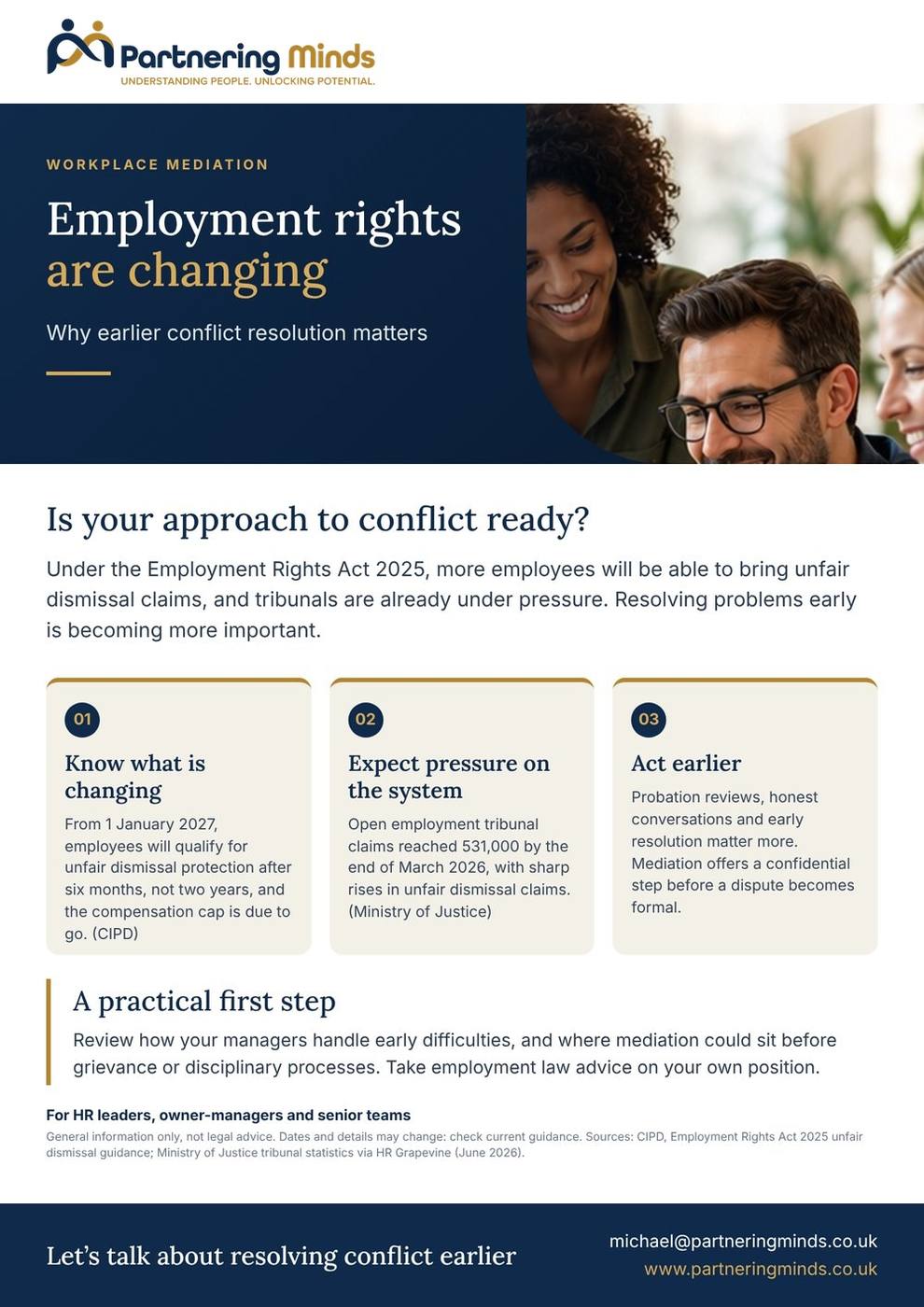
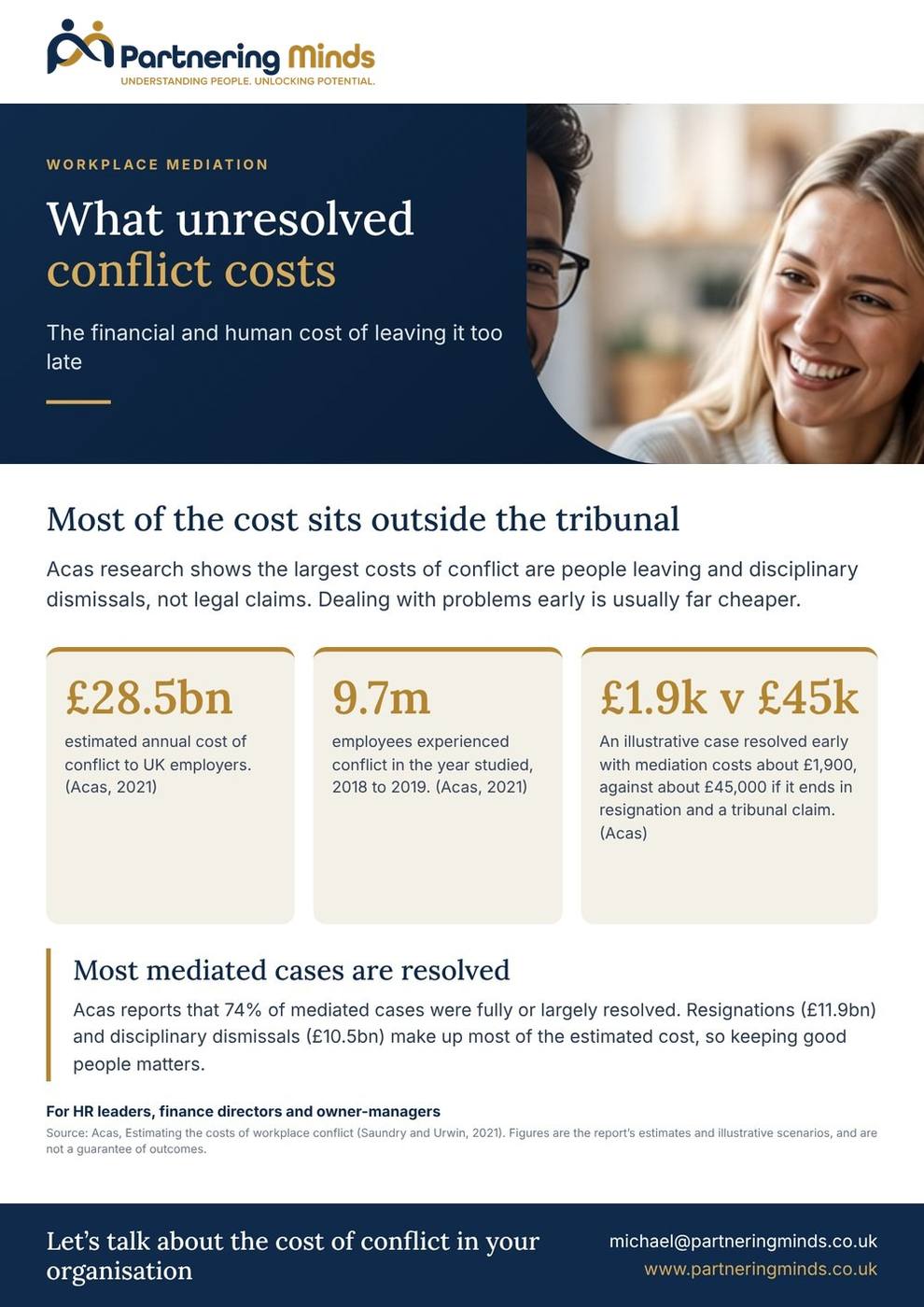
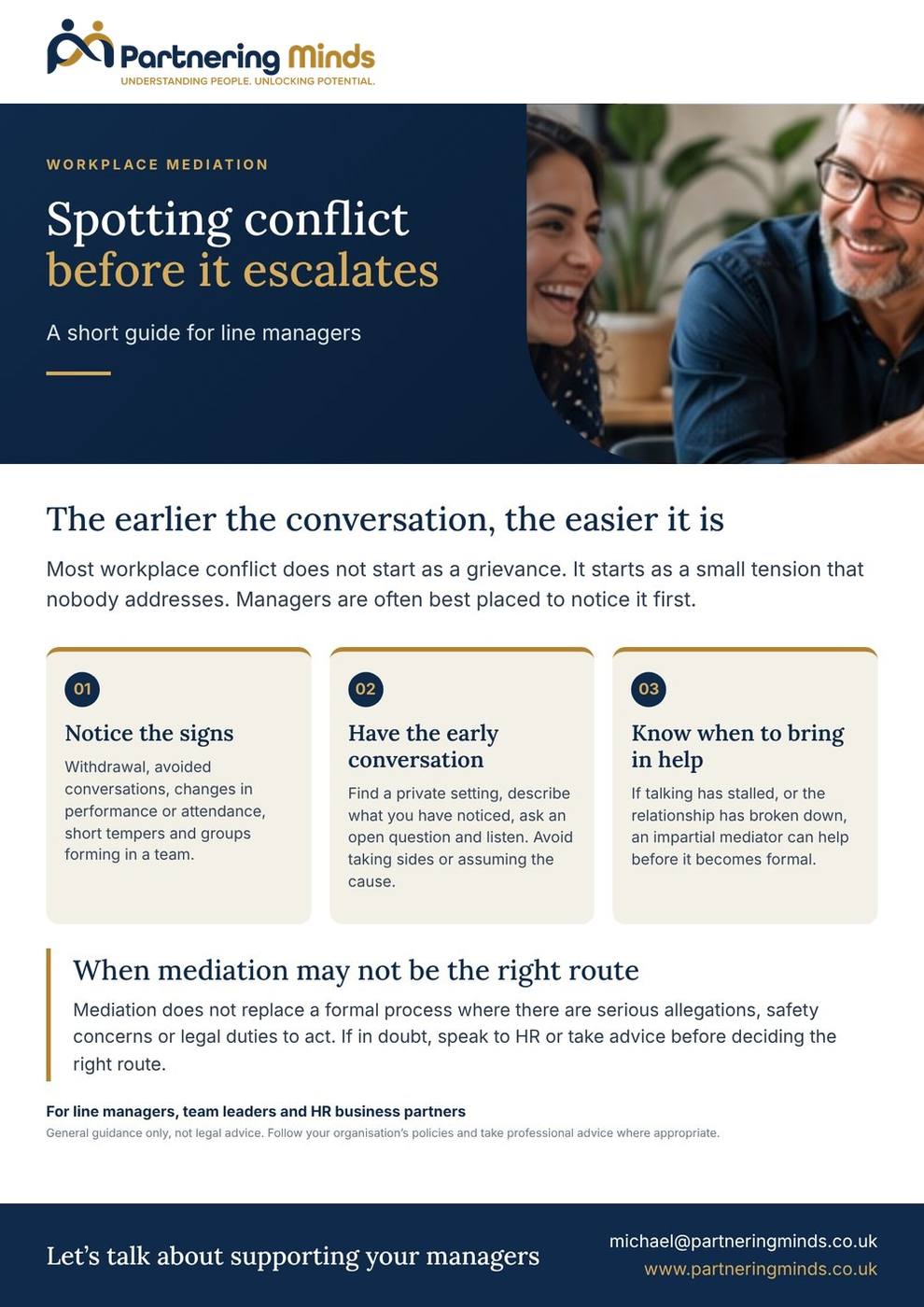
Four short leaflets for HR leaders, managers and owner-managers. Tap any leaflet to see it full size.
A confidential first conversation
If a working relationship has broken down, or you are worried it might, let’s talk through the situation and whether mediation would help. The first conversation is confidential and carries no obligation.
We think better when we don’t think alone.