

ICF Professional Certified Coach (PCC)

Understanding people. Unlocking potential.

Coaching

A confidential space to think clearly, and lead well.

Confidential coaching for senior leaders and executives, building self-awareness, emotional intelligence, judgement and resilience under pressure. Structured, practical and measured against what you actually want to change.

One to one

Executive and leadership coaching.

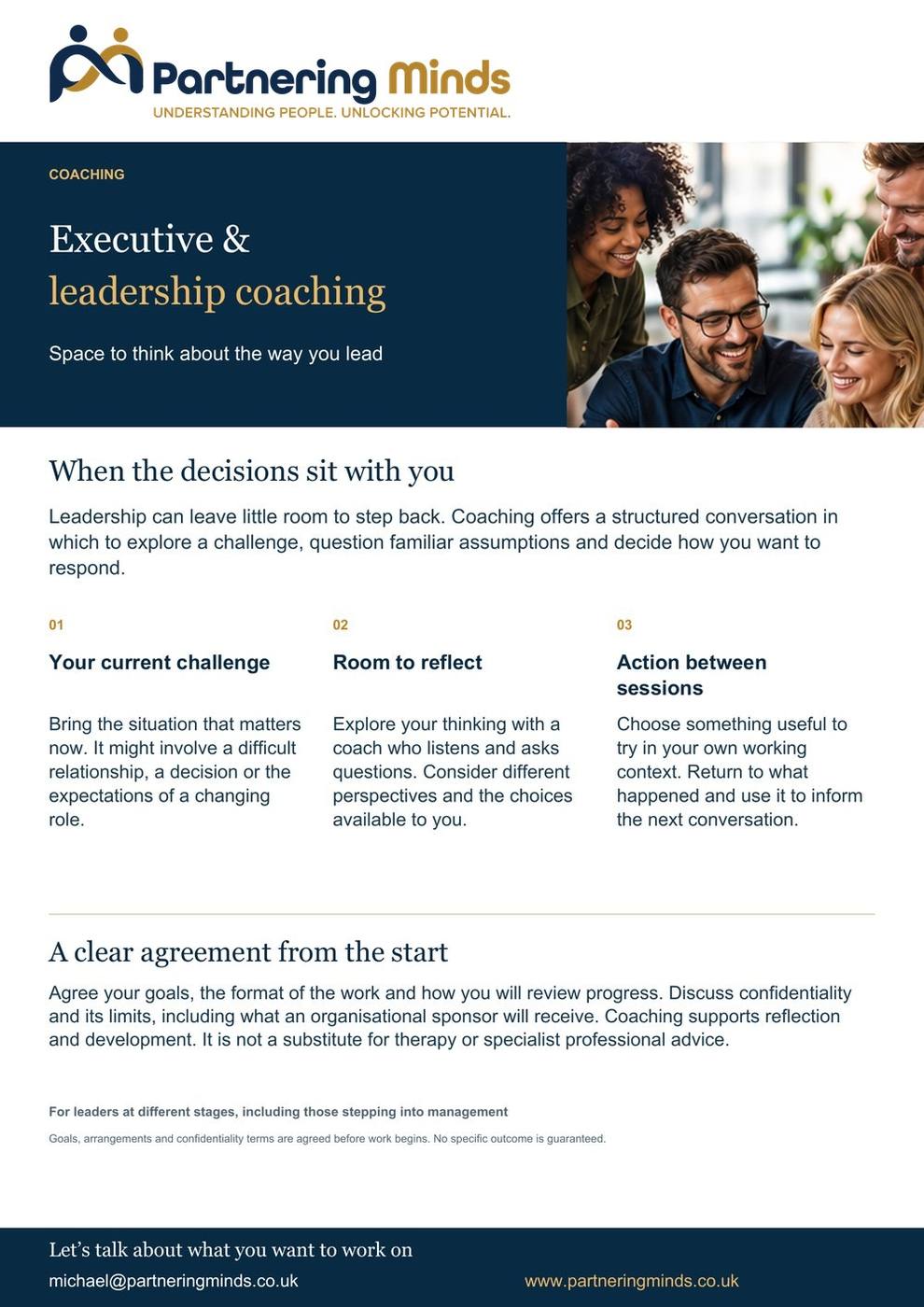
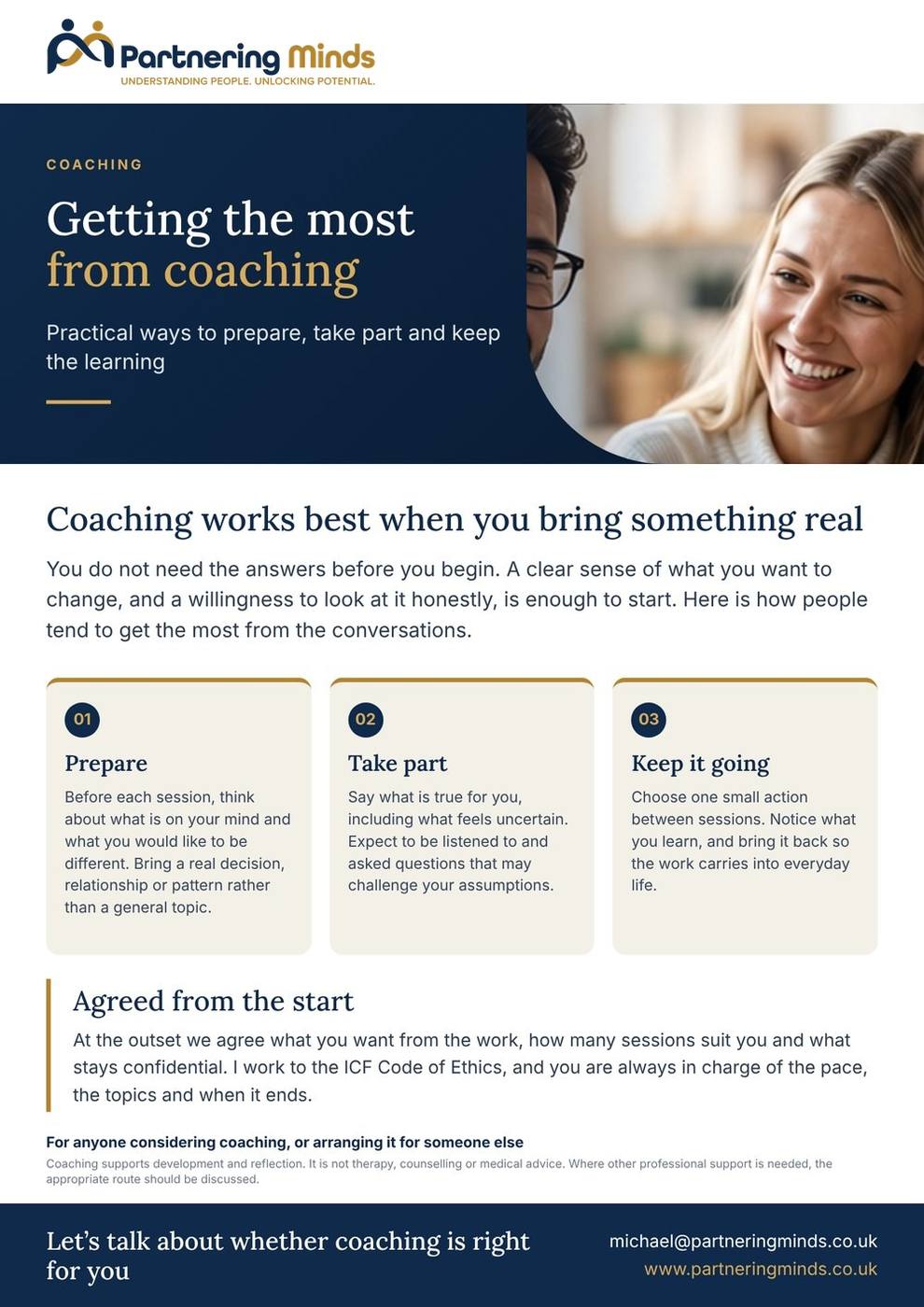
Coaching works best when you bring a real challenge: a bigger role, a pattern you can see but can’t shift, a difficult relationship or a decision that needs space to think.

Programmes can be a single session, three sessions or a full programme, and six is typical. Delivered by an ICF Professional Certified Coach with more than 900 logged coaching hours.

ICF Professional Certified Coach credential badge

Stepping into a bigger role

Make the shift from doing to leading, decide what to keep, what to let go of and how you want to be experienced.

Shifting a pattern

Understand what is behind a habit you keep repeating, and practise a different response in real situations.

A confidential sounding board

Talk through decisions, relationships and pressures with someone independent who will listen and challenge.

Leading through change

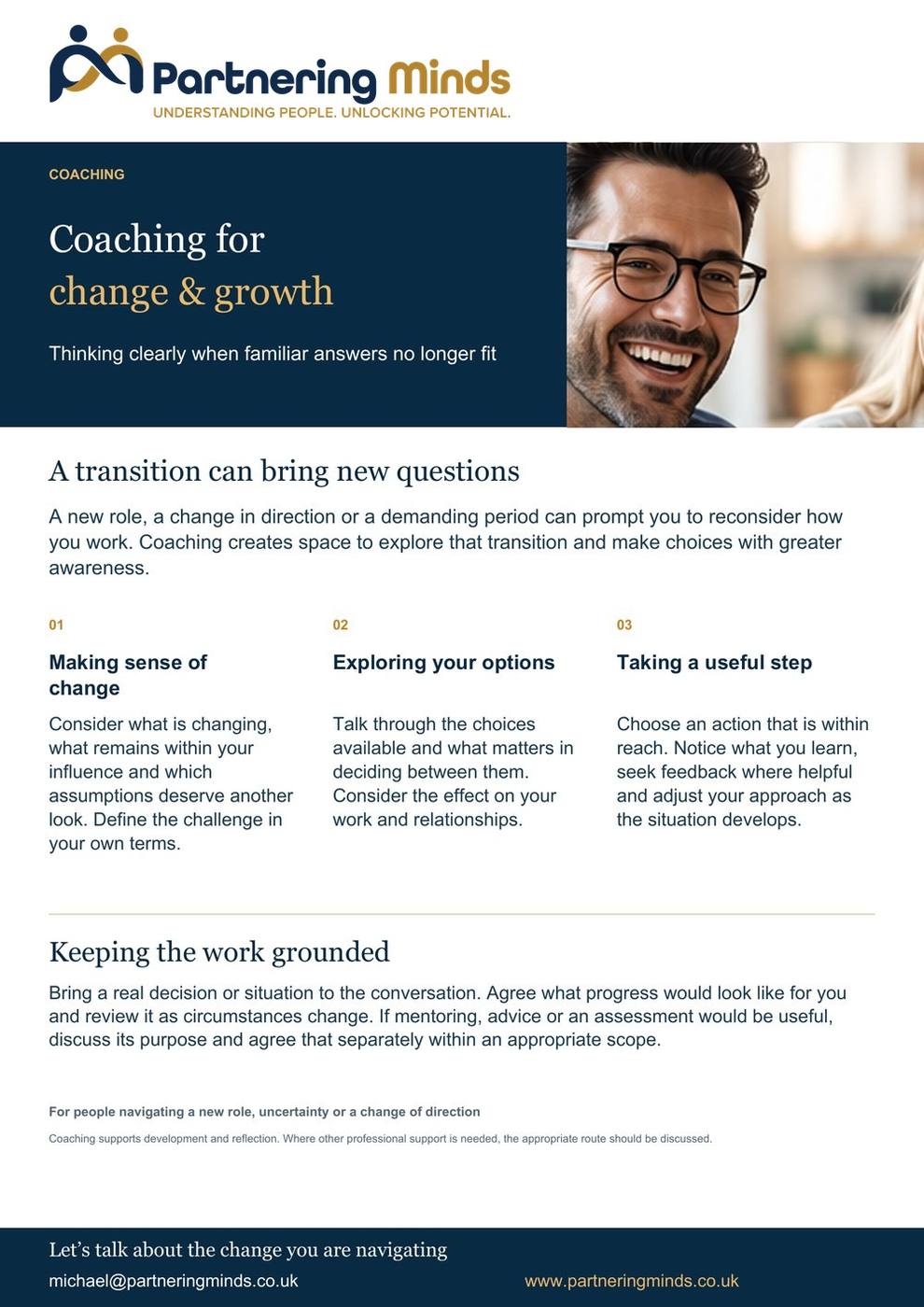
Build resilience, steady your team and keep your own judgement clear when things are uncertain.

Navigating a difficult relationship

Prepare for a hard conversation with a boss, peer or team member, and find a way to be direct without damaging trust.

Making a big decision

Weigh up a career move, a restructure or a change of direction, and get clear on what matters most before you commit.

What kind of coaching do you need?

From doing to being: three types of coaching

Not all coaching is the same. Some people need to build a skill, some need to deliver and sustain results, and some need to rethink how they lead. Knowing which helps you get the right support.

DOING BEING 01 Skills Learning how 02 Performance Delivering results 03 Developmental Who you are as a leader

Skills coaching

Building capability

What it focuses on
The specific knowledge and skills you need for your role, and how to practise them.
For example
A new manager learning to run effective one-to-ones and give feedback.
What changes
Confidence and competence in the skills that matter most right now.

Performance coaching

Delivering results

What it focuses on
Clear goals, accountability and the habits that turn intention into delivery.
For example
A leader whose team isn't yet owning and delivering their objectives.
What changes
Sharper priorities, better habits and results that hold over time.

Developmental coaching

Growing as a leader

What it focuses on
Your beliefs, values, story and how you show up, especially under pressure.
For example
An experienced director rethinking how they lead as the business grows.
What changes
Deeper self-awareness and lasting shifts in how you lead and relate to others.

Most coaching relationships move along this line. We start where you are, agree with you and your sponsor what you need, and go as deep as it takes.

The coaching journey

From insight to lasting change.

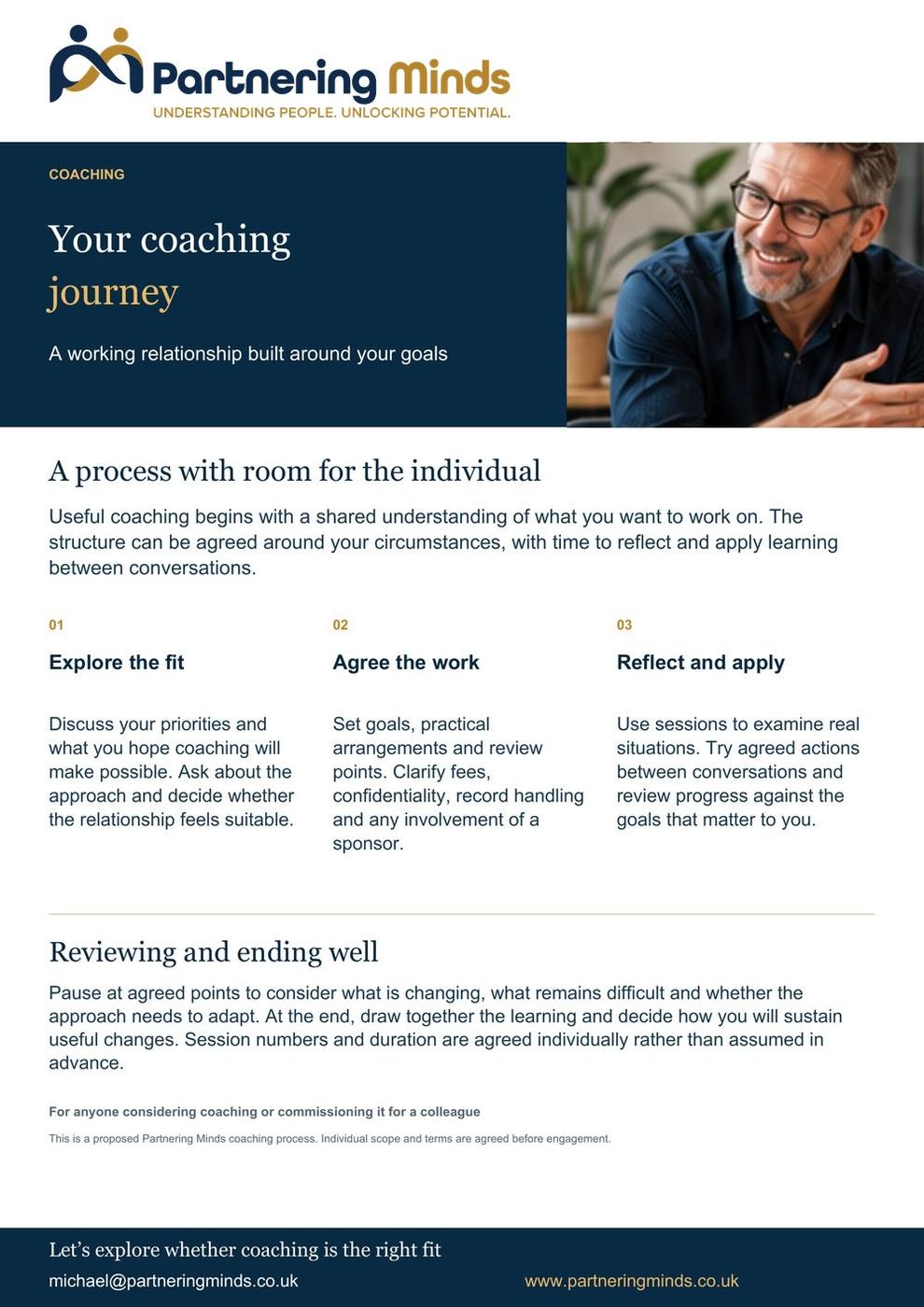
A typical one-to-one coaching programme runs over six sessions, though it can be as short as one or three. Whatever the length, it has a clear start, a structured middle and a proper close, so progress is visible to you and to your sponsor.

Swipe sideways to see the whole roadmap.

The Partnering Minds coaching journeyA winding road with eight stages: the opening brief and chemistry call; six coaching sessions, opening and closing with a three-way conversation with the sponsor or line manager; and the programme close. Partnering Minds UNDERSTANDING PEOPLE.UNLOCKING POTENTIAL. THE COACHING JOURNEY FROM INSIGHT TO LASTING CHANGE START ▸ LASTING CHANGE ThePartnering MindsCoaching Journey 01 Journey begins… Coaching brief shared Chemistry call with your coach Contracting and confidentiality agreed WITH SPONSOR 02 Session 1 Tri-party with sponsor / line manager (first 45 mins) Agree 3–4 measurable goals Homework: psychometric and Reframe Beliefs 03 Session 2 Psychometric debrief Reframe Beliefs debrief Strengths and blind spots explored 04 Session 3 360 feedback debrief Themes and priorities for change 05 Session 4 Mid-point progress check on goals Client-specific work 06 Session 5 Client-specific work Embed new habits Plan for lasting change WITH SPONSOR 07 Session 6 Tri-party review with sponsor / line manager (final 45 mins) What’s changed? Evidence against goals 08 Journey ends… Programme close Coach’s written summary Ongoing development plan Final client check-in PHASE 1 · DISCOVER PHASE 2 · DEVELOP PHASE 3 · EMBED BETWEEN SESSIONS Sessions every 4–6 weeks (90 mins) Practical actions to apply learning Articles, books and talks Voice-note access to your coach GREATER SELF-AWARENESS • STRONGER RELATIONSHIPS • REAL PROGRESS
Read the journey as a list
Partnering Minds

The coaching journey

From insight to lasting change

Start

  1. 01

    Journey begins…

    • Coaching brief shared
    • Chemistry call with your coach
    • Contracting and confidentiality agreed
  2. 02

    Session 1

    • Tri-party with sponsor or line manager (first 45 minutes)
    • Agree 3–4 measurable goals
    • Personal story and 360 set-up
    • Homework: psychometric profile and Reframe Beliefs exercise
  3. 03

    Session 2

    • Psychometric debrief
    • Reframe Beliefs debrief
    • Strengths and blind spots explored
  4. 04

    Session 3

    • 360 feedback debrief
    • Themes and priorities for change
  5. 05

    Session 4

    • Mid-point progress check on goals
    • Client-specific work
  6. 06

    Session 5

    • Client-specific work
    • Embed new habits
    • Plan for lasting change
  7. 07

    Session 6

    • Tri-party review with sponsor or line manager (final 45 minutes)
    • What’s changed? Evidence against the goals
  8. 08

    Journey ends…

    • Programme close
    • Coach’s written summary
    • Ongoing development plan
    • Final client check-in

Lasting change

Between sessions: sessions every 4–6 weeks, practical actions, curated resources and voice-note access to your coach.

  • Greater self-awareness
  • Stronger relationships
  • Real progress
1 · DiscoverJourney begins to Session 2

Build self-awareness through your story, psychometric profile and 360 feedback, and agree clear goals with your sponsor.

2 · DevelopSessions 3 to 5

Try new approaches in real situations at work, reflect on what happens, and adjust.

3 · EmbedSession 6 to programme close

Evidence what has changed, make new habits stick and leave with a plan to keep growing.

How we measure change

  1. Starting point

    Goals agreed with you and your sponsor in Session 1, with 360 feedback to show where you are now.

  2. Mid-point check

    In Session 4 we review progress against your goals and adjust where needed.

  3. Evidence review

    In Session 6 your sponsor rejoins us to look at real examples of what you are doing differently.

  4. Follow-up

    A check-in after the programme ends to see how the change is holding.

Optional: a short follow-up 360 at the end, to compare against your starting point.

Why it lasts

Real work, not theory

We work on the challenges you are facing now, in your role, with your team.

Practice between sessions

Four to six weeks between sessions gives you time to try new behaviours and see what works.

Accountability

Your coach and your sponsor both keep your goals in view, so progress doesn't drift.

Confidential by design. What you discuss stays between you and your coach. Your sponsor sees your goals and your progress, not the content of our conversations.

Coaching approach

Motivational interviewing: helping you find your own answers.

Most of us don't change because someone tells us to. We change when we hear ourselves say why it matters, and what we're going to do about it.

As a motivational interviewing practitioner, I use a structured, respectful way of talking that draws out your own motivation, rather than pushing advice at you. It's particularly useful when you feel torn about a decision, or when you know what you should do but haven't done it yet.

How it helps in coaching

  • Working with mixed feelings. Wanting to change and not wanting to change are both normal. We explore both honestly, without judgement.
  • Your reasons, not mine. Questions and reflections help you articulate what matters to you, which is what sustains change.
  • Less resistance. Because you stay in charge of the direction, there's nothing to push against.
  • Clear next steps. The conversation moves from "should I?" to "how will I?", with commitments that are realistic and yours.

The detail

What motivational interviewing is, and why it helps people change.

What it is

Motivational interviewing (MI) is a collaborative, goal-focused style of conversation, developed by the psychologists William Miller and Stephen Rollnick. It began in work on addiction and is now widely used in health, social care, coaching and leadership. Its aim is to strengthen a person’s own motivation and commitment to change.

The spirit behind it

MI rests on four ideas: partnership (we work on it together), acceptance (respecting your choices and strengths), compassion (your wellbeing comes first) and evocation (drawing out what you already know and want, rather than telling you what to do).

The core skills

Four skills do most of the work: open questions that invite you to think, affirmations that recognise what you are already doing well, reflective listening that checks and deepens understanding, and summaries that pull what you have said into a clear picture.

Why people resist being told

When someone tells us what we should do, we tend to defend the opposite. It is a natural reaction, and it is why advice and persuasion often fail. MI avoids that trap by letting you make the case for change in your own words, which is far more likely to stick.

How a conversation moves

MI follows four connected steps: engaging (building trust), focusing (agreeing what to work on), evoking (exploring your own reasons and confidence) and planning (agreeing realistic next steps you are ready to commit to).

Where it helps at work

Leaders use it when they need someone to take on feedback, adopt a new way of working, delegate, or tackle a habit that is holding them back. It does not guarantee change, because the decision is always yours, but it makes honest, committed change far more likely.

Useful beyond the coaching room

The same skills help managers have better performance, development and change conversations. I can build them into leadership programmes, so that leaders learn to ask, listen and guide rather than tell.

Coaching approach

Applied neuroscience: understanding how the brain shapes behaviour.

Applied neuroscience takes research from fields such as psychology, biology and cognitive science on how the brain develops and works, and turns it into practical tools for everyday life and work. It helps explain why people think, feel and act the way they do, and how to work with the brain rather than against it.

I hold a Certificate in Applied Neuroscience, and I use these ideas to help you understand your own patterns, manage pressure, build new habits and make clearer decisions. It informs my coaching and does not replace it. I am a coach, not a neuroscientist, and this is not clinical advice.

How I use it in coaching

  • Understanding your patterns. Why we repeat habits, and what it takes to build new ones that last.
  • Managing pressure. How stress affects thinking and behaviour, and practical ways to steady yourself.
  • Making better decisions. Noticing what shapes the way we weigh up options and follow through.
  • Learning and change. How we take in, remember and apply new things, so that changes stick.
  • Working with others. Why people react the way they do, including the people you lead.

Leaflets

Coaching at a glance.

Four short leaflets about how coaching works. Tap any leaflet to see it full size.

Case studies

What coaching looks like in practice.

Two examples of the work. Names and organisations are withheld to respect confidentiality.

Coaching case study · Redundancy and career transition

From redundancy to a senior role, and a promotion within nine months

Situation

A Director in a large organisation faced redundancy after an organisational redesign and restructure. He had not updated his CV for over a decade or been through a formal interview in that time. The redundancy hit his confidence and he questioned his relevance in the current job market.

Approach

We reframed his career narrative so he could see the depth and transferability of his skills, through structured coaching on his career history, leadership impact and strengths.

The work combined practical support (CV, interview preparation and market positioning) with developmental coaching to rebuild confidence and mindset.

Impact

As his confidence grew, he presented himself with greater authority and authenticity. He secured a senior role in a larger organisation in a new sector, and was promoted within nine months.

“Michael helped me contextualise my wider career history, experience and skills, and bring out the confidence I had in myself… His personal commitment, positivity, knowledge and drive helped me to adjust my mindset and enable me to believe in myself, build confidence, so I could succeed.”Director, outplacement coaching client
Coaching case study · Leadership style and wellbeing

From organisational “fixer” to empowering leader

Situation

An Operations Director, 25 years in the same organisation, was capable, committed and deeply knowledgeable, but carried too much personally. As the business entered a new phase of growth, his CEO asked for support. Feedback pointed to delegation, empowering his team, empathetic communication and embedding change, alongside concerns about stress.

Approach

Reflective, challenging conversations explored how his long tenure and personal investment shaped his behaviour. We worked on:

  • Delegation and accountability in his team
  • Empathy and emotional intelligence
  • Communication that brings people with him
  • Structured change methods
  • Personal wellbeing and resilience

Impact

He stepped back from operational firefighting and invested in developing his team. His communication became more measured and intentional, and he embraced his own development with renewed energy, enjoying the process and seeing tangible growth.

“You have proved what was left of the cynic in me entirely wrong… I am certain I have enjoyed the ride and am benefitting greatly from the work you have put in. I am hell bent on continuing my personal and professional development.”Operations Director, executive coaching client

Optional insight

Evidence to start the conversation.

Coaching can be enriched with a psychometric or feedback tool, always translated into practical development rather than left as a report on a shelf.

Hogan

Everyday style, patterns under pressure and the values driving your decisions.

EQ-i 2.0 and EQ 360

Your emotional and social skills, and how others experience you.

Insights Discovery

A memorable language for how you communicate and work with others.

Belbin

The contributions you make and how they fit with the people around you.

Confidential, developmental, yours

What you share in coaching stays confidential, with the limits agreed at the start. Where a sponsor is involved, we agree in advance what they will and won’t see. Coaching is developmental, not therapy, and we’ll talk openly if other support would help.

Professional standards

What it takes to be a PCC, and the ethics I work to.

The ICF Professional Certified Coach credential is not a certificate you buy. It has to be earned through training, hands-on experience, being assessed and passing an exam, and it comes with a Code of Ethics I am held to.

What it takes to earn it

The ICF’s published requirements for the PCC credential.

  • 125 hours of coach-specific training
  • 500 hours of coaching experience, at least 450 of them paid
  • 10 hours of mentor coaching with an ICF mentor coach
  • A performance evaluation, where recorded coaching is assessed against the ICF Core Competencies
  • Passing the ICF Credentialing Exam

I have more than 900 logged coaching hours, and I wrote about the day I passed in my article on becoming a PCC.

The ethics I work to

As a credential-holder I work to the ICF Code of Ethics, updated in 2025.

  • Clear agreements. Roles, fees and confidentiality are agreed in writing before we start.
  • Confidentiality. What you say stays between us. We agree in advance any exceptions, such as legal requirements or risk of harm, and what, if anything, is shared with whoever is paying.
  • Conflicts of interest and boundaries. I name them early and deal with them openly, and I tell you if I am ever acting in a different role.
  • Competence and honesty. I describe my qualifications accurately, work within my competence and refer you on when someone else is better placed.
  • Looking after your records. Including when technology or AI tools are used.
  • Accountability. Breaches can be reported to the ICF, which can apply sanctions up to loss of the credential.

The Code rests on four values: professionalism, collaboration, humanity and equity. Read the ICF Code of Ethics and the PCC requirements on the ICF website.

Start with a conversation.

A 30-minute chemistry call, no pitch. We’ll talk about what you want to change and whether I’m the right coach for you.

  • ICF Professional Certified Coach
  • Insights Discovery Licensed Practitioner
  • Hogan certified
  • EQ-i 2.0 certified
  • Belbin
  • SLII Qualified Facilitator
  • Accredited Mediator, UK Mediation
  • MHFA England Instructor Member
  • Certified NLP Practitioner
  • Certified NLP Master Practitioner
  • Certified in Applied Neuroscience