Understanding people. Unlocking potential.
Belbin Team Roles
Understand what each person brings and help your team work better together
A team can have plenty of talent and still struggle to get things done. Some conversations circle without a decision; some good ideas never become action. Belbin helps us explore the contributions people make and how those contributions work together. At Partnering Minds, we use that understanding to help teams have better conversations and make practical progress.
What it is
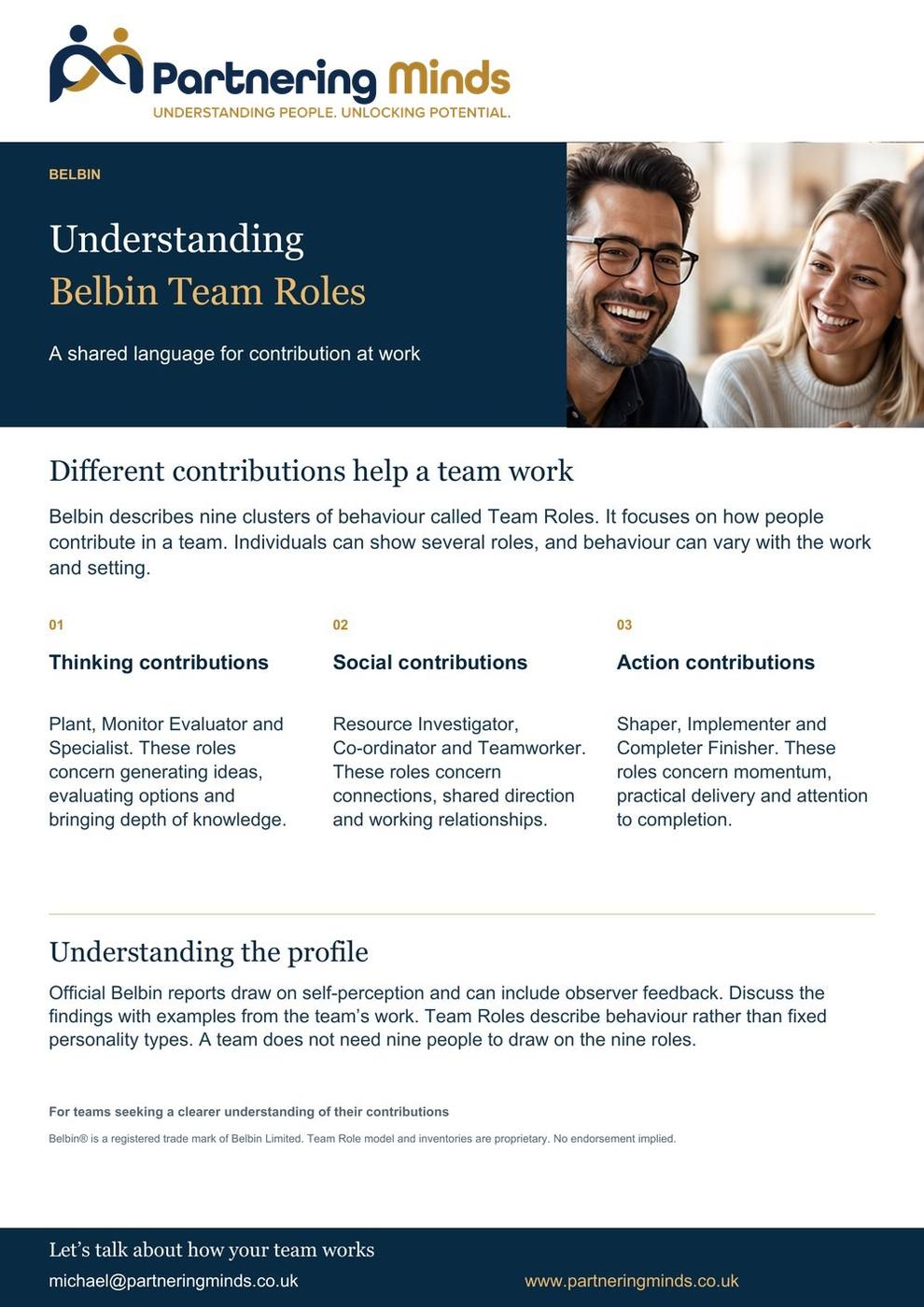
Nine clusters of behaviour that contribute to teamwork.
Developed from Dr Meredith Belbin’s research into teams at Henley, Belbin Team Roles is a framework describing nine clusters of behaviour that contribute to teamwork. It focuses on how people contribute at work, rather than assigning a fixed personality type or job title. Individuals usually bring a combination of roles.
Social contributions
Resource Investigator explores opportunities and connections. Teamworker supports cooperation. Co-ordinator clarifies goals and draws out contributions.
Thinking contributions
Plant generates original ideas. Monitor Evaluator weighs options and exercises judgement. Specialist brings depth of expertise.
Task contributions
Shaper provides drive and challenge. Implementer turns plans into practical action. Completer Finisher checks details and helps bring work to completion.
From understanding to practical progress
Getting the best out of people and teams.
Recognise different strengths
See the value in contributions that may be quieter, less visible or different from your own.
Coordinate work more deliberately
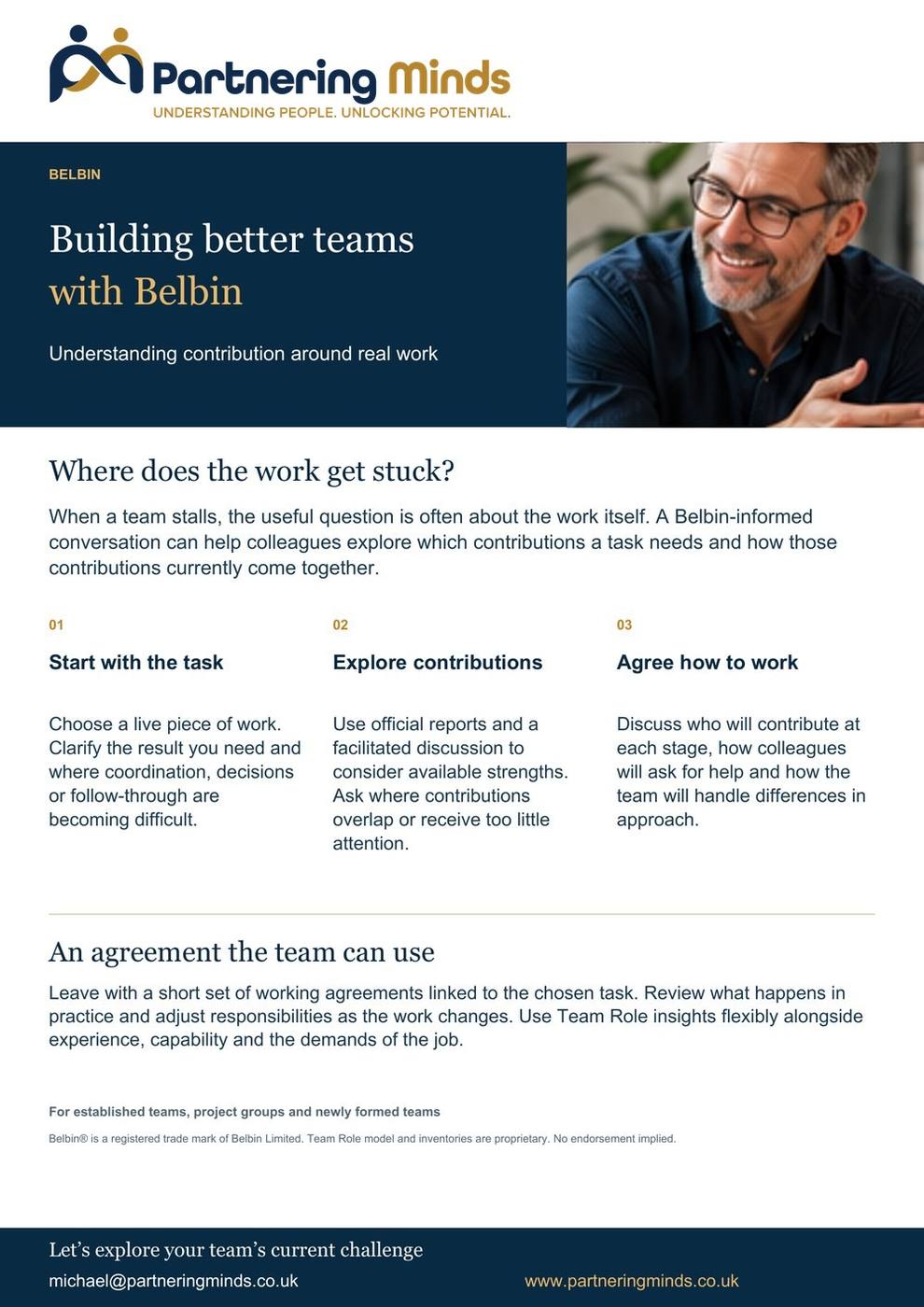
Discuss who can contribute what, where work gets stuck and what support the team needs.
Replace assumptions with conversation
Explore how colleagues experience your behaviour and agree useful changes together.
Where it can help
Where this can make a difference.
Existing teams facing friction
Use the Team report to explore overlaps and gaps in contributions. Turn “we always clash” into a discussion about the work, the behaviours it needs and how people can support one another.
New teams and project groups
Consider what the next phase requires: ideas, evaluation, coordination, delivery or quality checking. Agree responsibilities using role insights alongside expertise, capacity and accountability.
Leaders developing others
Ask whose strengths are underused and where one person is carrying too much. Invite contributions, develop capability and make delegation a conversation rather than a profile-based allocation.
Coaching and transitions
Explore how your own view compares with observer feedback. Identify a contribution to develop, a relationship to strengthen or an opportunity to work differently in a new role.
Teams under pressure to deliver
When deadlines tighten, teams lean on their most comfortable roles and gaps start to show. Spot which contributions are missing, such as checking detail or challenging assumptions, and agree who will step in.
Leadership and senior teams
Senior teams often share similar strengths and the same blind spots. Explore the balance of contributions around the table and how the team can make better, more rounded decisions.
Leaflets
Belbin at a glance.
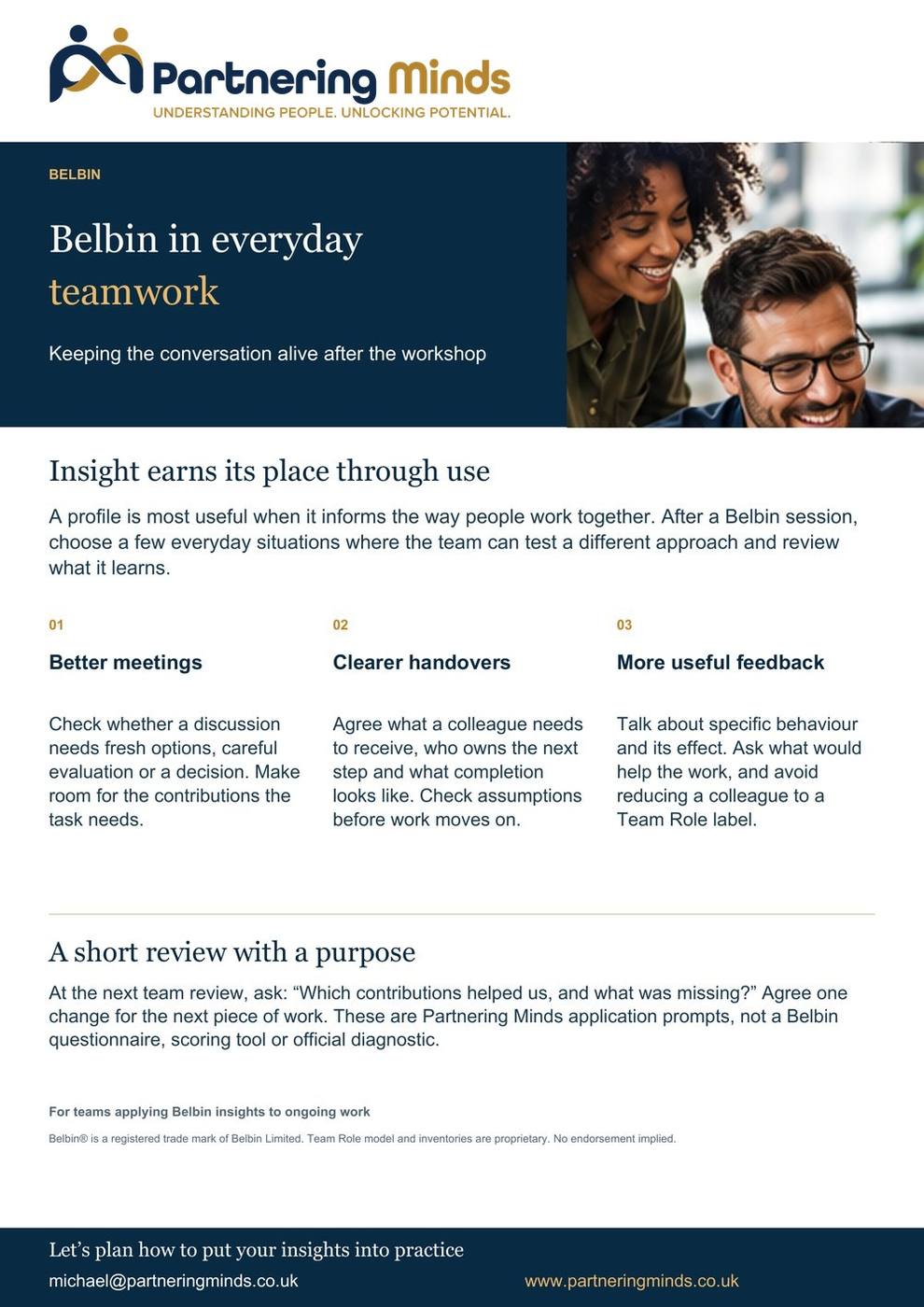
Three short leaflets you can read, share with colleagues or bring to a team conversation. Tap any leaflet to see it full size.
How we work together
From first conversation to practical change.
Step 1
Start with the team’s challenge
Agree the purpose, participants and desired changes. Explain report access, observer feedback and what information may be shared with the group.
Step 2
Gather individual perspectives
Participants complete the official online Self-Perception Inventory, which Belbin estimates takes around 20 minutes. Add feedback from colleagues who know their work.
Step 3
Explore the team in practice
Debrief individual findings and use the Team report to discuss collective contributions. For example, a team generating ideas but missing deadlines might review how ideas become agreed plans and checked deliverables.
Step 4
Agree actions and revisit them
Choose practical commitments, owners and a review date. Look for changes in behaviour and delivery, rather than treating the report or a preferred role as the outcome.
Questions and responsible use
What to know before you begin.
Do we need nine people or one of every role?
No. People can contribute through more than one role, and the work determines which behaviours are needed at a particular stage. There is no universal recipe for the perfect team.
Why include Observer Assessments?
They add colleagues’ perspectives to the self-report. Belbin recommends inviting six observers and requires at least four responses for an Individual report incorporating observer feedback. Ideally, observers have worked closely with the person for at least three months.
What are allowable weaknesses?
Belbin uses this term for a potential downside associated with a strength. For example, attention to detail may come with difficulty letting go. We discuss the impact and support needed; the term never excuses disrespect, poor conduct or avoiding responsibility.
Is Belbin a fixed label or a recruitment shortcut?
No. Behaviour is influenced by the working context and can develop over time. This offer is for development; a profile should not determine someone’s suitability for a job or promotion by itself.
How long does it take?
The online Self-Perception Inventory takes around 15 to 20 minutes, and each observer needs only a few minutes. Allow a week or two to gather observer responses. Team workshops typically run from a half day to a full day.
Who sees the reports?
Individual reports belong to the participant and are discussed with them first. We agree in advance what is shared in a team session, which is usually each person’s main team roles rather than their full report.
Using the approach responsibly
Self-perception and observer feedback are perspectives to explore, not objective verdicts. We consider who had an opportunity to observe, and possible bias or differences between contexts. We agree confidentiality, sharing and retention before participation, and explain any limits to observer anonymity. We use official licensed reports rather than copied questionnaires. Belbin does not measure technical skill, intelligence or mental health, and cannot guarantee team performance.
Your practitioner
I am a Belbin specialist.
Belbin fits our belief that we think better when we don’t think alone. I bring listening, constructive challenge and facilitation to connect the framework with your team’s actual work.
Belbin Team Roles specialistA useful next conversation
If your team is working hard but not working well together, let’s explore what is happening and whether Belbin would be a useful starting point.
We think better when we don’t think alone.