Understanding people. Unlocking potential.
Hogan Assessments
Understand your leadership beyond your own perspective
The way you intend to lead and the way others experience you can differ. Hogan Assessments offers another lens on your everyday style, the patterns that may become unhelpful under pressure and the values driving your decisions. We help you connect that insight with the leadership challenges you are facing.
What it is
Three complementary perspectives.
Hogan’s three core personality assessments offer complementary perspectives. The Hogan Personality Inventory explores everyday interpersonal tendencies. The Hogan Development Survey examines potential derailers. The Motives, Values, Preferences Inventory explores what matters to you at work. Together, they can support a richer development conversation than any single score.
HPI: Hogan Personality Inventory
Seven primary scales explore how you tend to relate to others when functioning well. Relevant to everyday leadership style and working relationships.
HDS: Hogan Development Survey
Eleven scales explore behavioural risks that can emerge under strain. These patterns may undermine relationships or effectiveness if unmanaged.
MVPI: Motives, Values, Preferences Inventory
Ten primary scales explore core goals, values and interests, informing conversations about motivation and working environments.
From understanding to practical progress
Getting the best out of people and teams.
See patterns more clearly
Explore where your usual approach serves you and what colleagues may experience differently.
Prepare for pressure
Notice situations that may trigger less helpful behaviour and decide how you want to respond.
Lead with greater awareness
Connect your drivers with the expectations, choices and culture you create for others.
Where it can help
Where this can make a difference.
A new leadership role
Explore the shift from individual contribution to leading through others. Identify the habits to retain, the behaviours to adapt and the feedback to seek.
Executive coaching
Bring a recurring leadership challenge to the debrief. Compare assessment hypotheses with actual examples, then choose one or two changes to practise.
Leadership teams under pressure
After individual debriefs, explore agreed collective themes. Consider how the group challenges ideas, handles uncertainty and manages disagreement without turning individual scores into public labels.
Motivation and organisational culture
Use MVPI to examine what leaders reward and what they may overlook. Discuss how to make room for different motivations and perspectives rather than expecting everyone to share the same values.
Succession and high-potential talent
Give emerging leaders an honest picture of their strengths, blind spots and potential derailers early, so their development plan targets what will matter most at the next level.
Senior hires and onboarding
Help a newly appointed leader settle in faster. Use their profile to shape a focused first 90 days, anticipate likely friction points and build strong working relationships from the start.
Leaflets
Hogan at a glance.
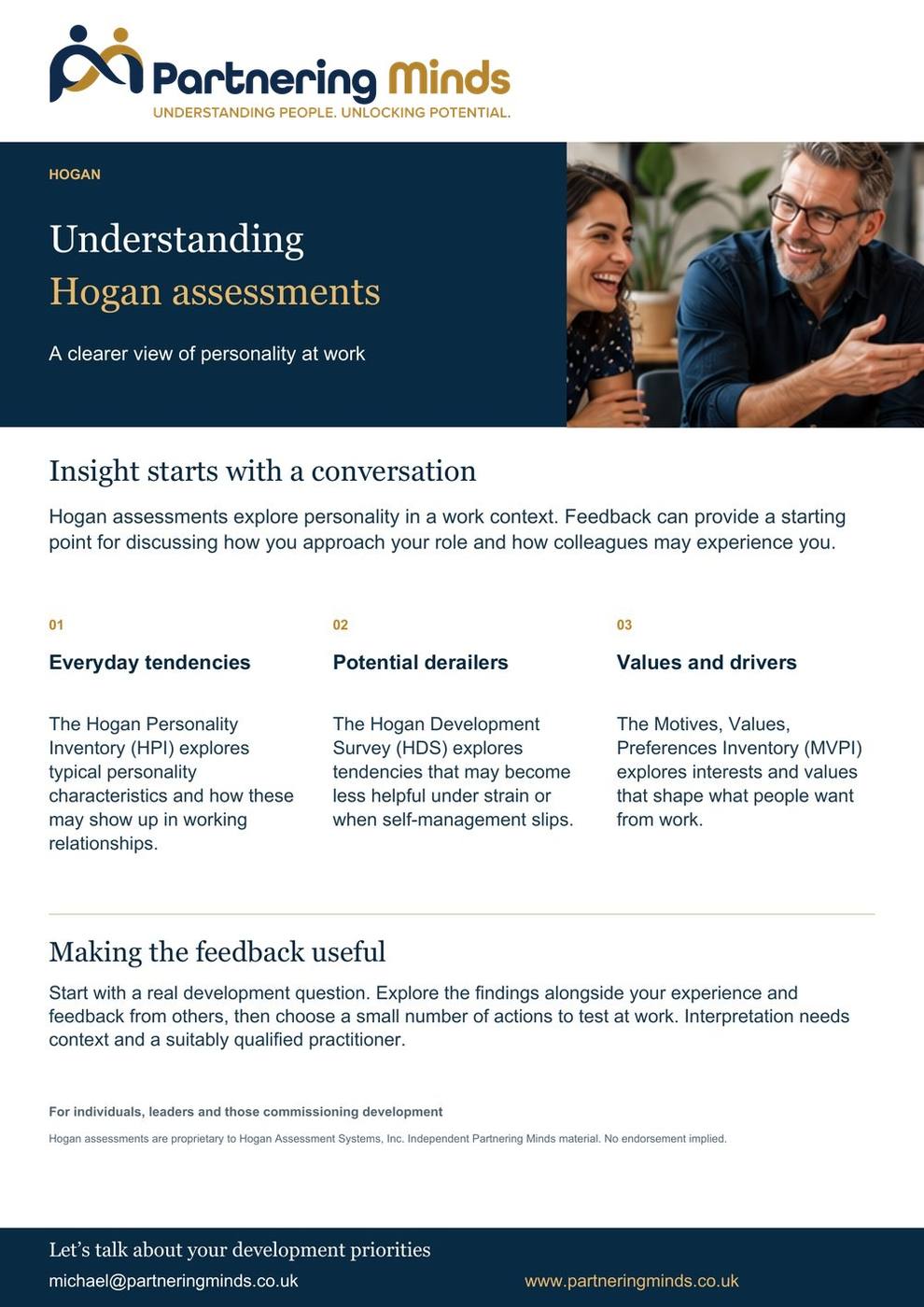
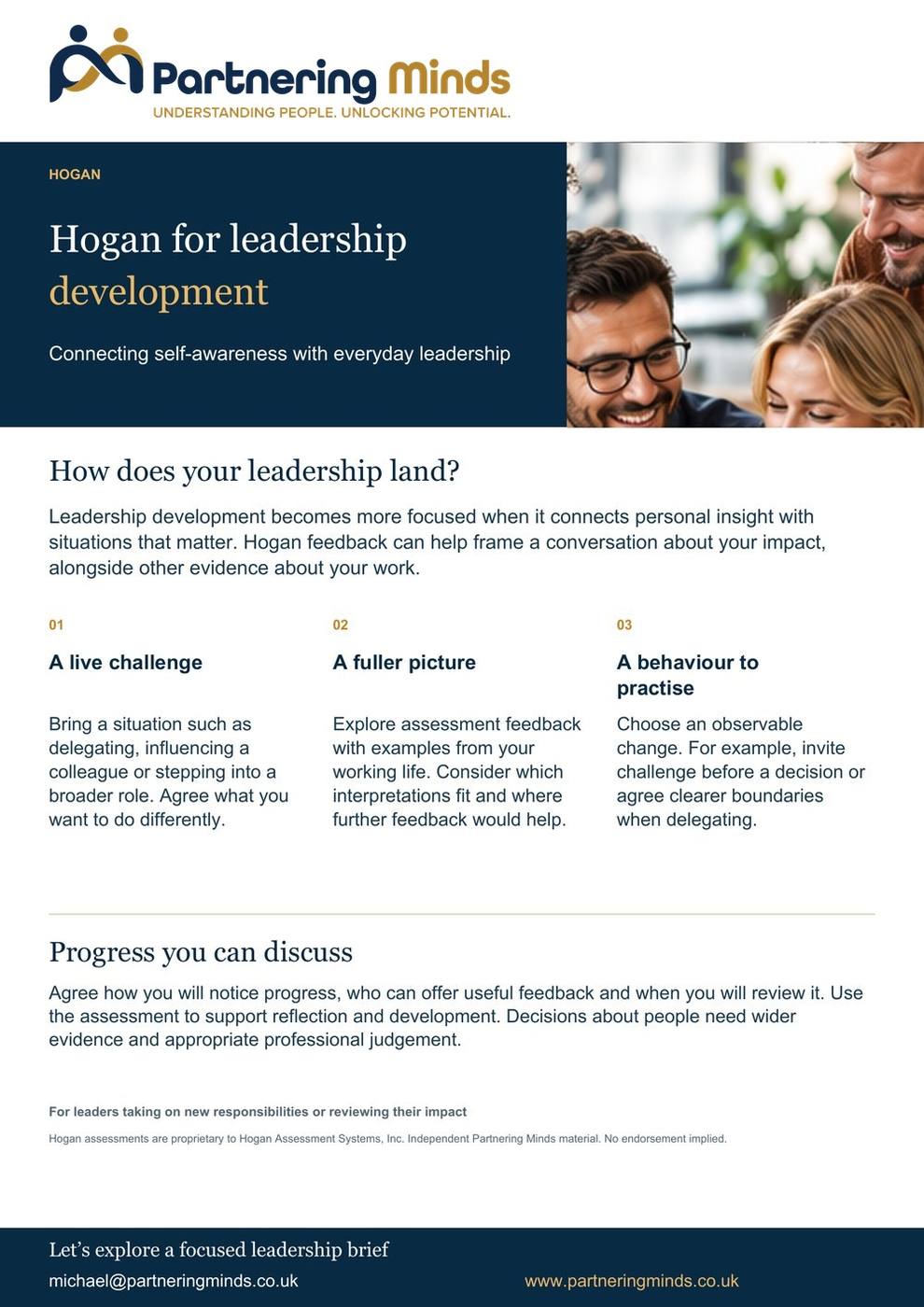
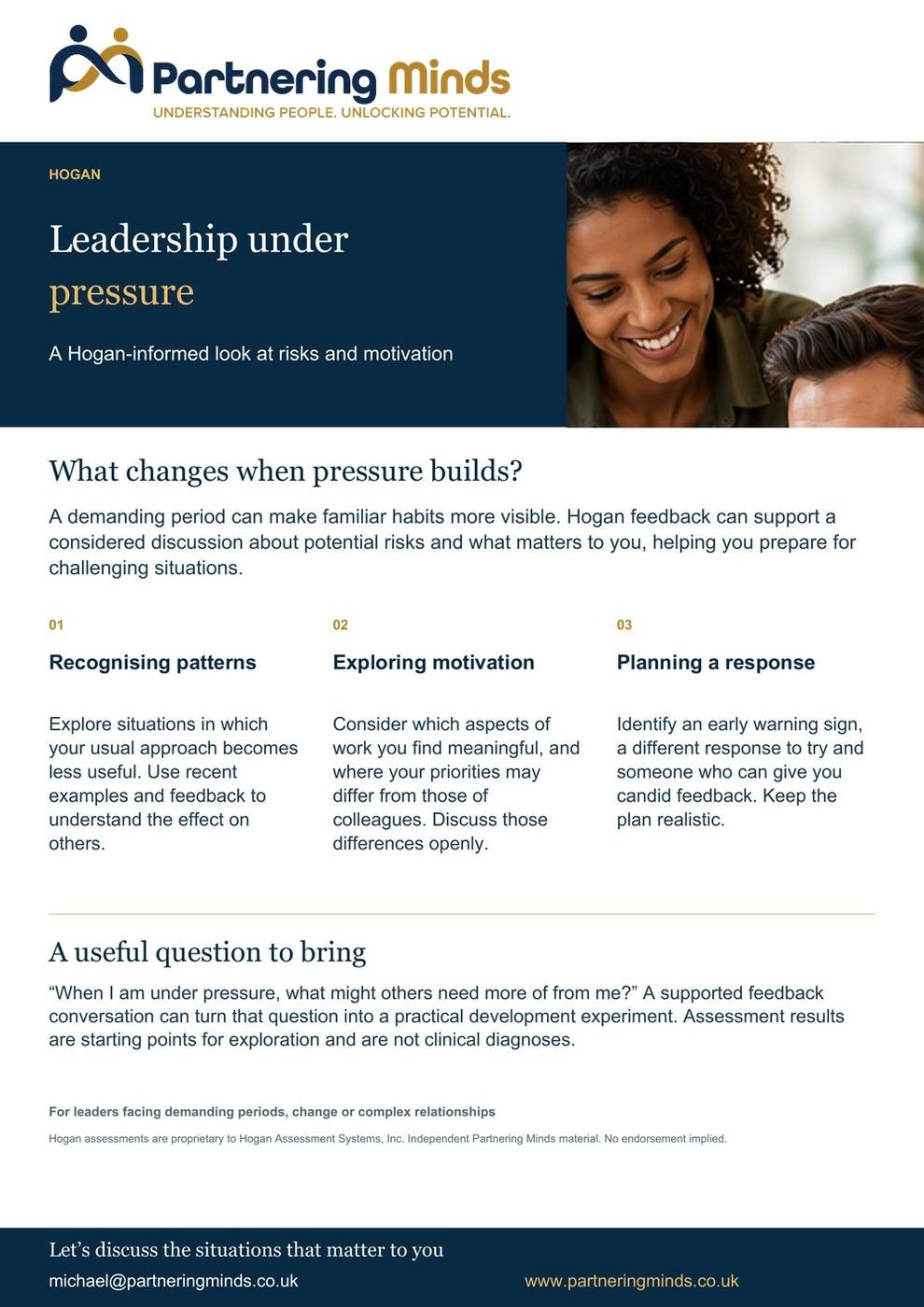
Three short leaflets you can read, share with colleagues or bring to a conversation. Tap any leaflet to see it full size.
How we work together
From first conversation to practical change.
Step 1
Agree the development question
We clarify the role, challenge and desired change. We agree report access, confidentiality and what, if anything, the sponsor will receive.
Step 2
Complete the assessments
HPI, HDS and MVPI are completed online. Hogan estimates around 15–20 minutes for each assessment; allow additional time for instructions and breaks.
Step 3
Make sense of the results
A supported debrief explores patterns across the assessments alongside your work context and feedback. Scores open a discussion; they do not settle it.
Step 4
Build and review an action plan
Choose observable behaviours, identify support and agree a review point. Coaching or a team session can help apply the learning to decisions, relationships and ways of working.
Questions and responsible use
What to know before you begin.
Is the HDS a mental health assessment?
No. In this development context it explores potential workplace behavioural risks. It does not diagnose a disorder or establish that someone is unsafe or incapable. Avoid clinical labels and personal judgements.
Are high scores always good?
No. The meaning depends on the scale, pattern, role and situation. For example, confidence may help someone act decisively while also making it harder to hear challenge. Interpret the full profile with a qualified practitioner.
Is Hogan the same as 360 feedback?
No. These questionnaires are completed by the participant. They offer personality-based insights into likely workplace behaviour; they do not directly collect colleagues’ ratings. Feedback can add a useful separate perspective.
Can Hogan support recruitment?
Hogan offers selection applications, but the service described here is developmental. Any selection project needs a separate, role-relevant design, appropriate evidence, fair interpretation and multiple sources of information.
Who sees my results?
You do. Your reports are confidential to you and me, and we agree before you start exactly what, if anything, is shared with your manager or sponsor. Often that is a short summary of your development goals, written by you, rather than the reports themselves.
Can my results change over time?
Personality is fairly stable, but behaviour is not fixed. With awareness and practice, people learn to play to their strengths and manage their risks, so others experience them differently. The aim is not to change who you are, but how well you use it.
Using the approach responsibly
Treat results as evidence to explore, not a fixed prediction of someone’s career. Consider response quality, context, language and the suitability of the comparison group. Explain the purpose, provider processing arrangements, access and retention before assessment. Agree what can be shared with a sponsor or team; do not circulate individual HDS results in group presentations. Assessment data should never be the sole basis of a consequential people decision.
Your practitioner
I am a Hogan certified practitioner.
Results are explained in a confidential, supported debrief and turned into practical development actions.
A useful next conversation
You do not need another report on the shelf. Bring the leadership question you want to work on, and we can explore whether Hogan is a useful place to start.
We think better when we don’t think alone.